

Direct Flow RO Water Filter
What is Direct Flow RO Water Filter
A Direct Flow Reverse Osmosis (RO) water filter system is a type of water purification technology designed to remove a wide range of contaminants from drinking water, including bacteria, viruses, chemicals, and heavy metals. The "direct flow" designation refers to how the water passes through the filter system.
Why Choose Us
Our History
Ningbo Blue Pluser Appliance Co.,Ltd sarted from bottled water since 1995 make bottled water, bottled water pump, bottled water handle etc.
Our Factory
With 300 skilled professionals and seven advanced production lines, our factory is a testament to precision engineering and technological prowess.
Our Certificate
We have the NSF, Water Mark, LFGB, FDA, SGS, WQA, CE, RoHS, UL, CCC, ISO 9001, ISO 14000:14001 certifications.
Product Application
Our water filtration systems find application across diverse sectors, including, reverse osmosis water filtration, coffee machine filter, residential, commercial, and industrial settings.
Production Market
Our footprint extends across the globe, with products reaching over 50 countries. The international market presence is a testament to the trust and confidence that customers place in our water filtration solutions.
Our Service
Beyond manufacturing, Blue Pluser places a strong emphasis on customer satisfaction. Our commitment to service goes beyond the sale, as we provide comprehensive support to our customers.
-
![800GPD Direct Flow RO System]() 800GPD Direct Flow RO System800GPD RO system with PP+Carbon Block+800G RO+Alkaline filter with digital display show TDSread more
800GPD Direct Flow RO System800GPD RO system with PP+Carbon Block+800G RO+Alkaline filter with digital display show TDSread more -
![Traditional Direct Flow RO Water Filter]() Traditional Direct Flow RO Water Filter◆ Traditional 5 stage RO System Water Filterread more
Traditional Direct Flow RO Water Filter◆ Traditional 5 stage RO System Water Filterread more
◆ With standard 10" x 2.5" PP + GAC + CTO + 75GPD RO + Coconut carbon
◆ With pressure gauge, booster pump, faucet, pipe etc. ... -
![500GPD Direct Flow RO Water Filter]() 500GPD Direct Flow RO Water Filter◆ Under Sink Space Saver Super Slim Designread more
500GPD Direct Flow RO Water Filter◆ Under Sink Space Saver Super Slim Designread more
◆ Multi Filter (PP + Carbon) + 500G RO + Alkaline
◆ With 2 outlet for drinking and purified water
◆ Zero Flood Risk with Auto... -
![500 Gallon Direct Flow RO Water Filter]() 500 Gallon Direct Flow RO Water Filter◆ With 3 stage twist filter 1st stage PP + Carbon, 2nd Reverse Osmosis Membrane 3rd stage T33 (available with alkaline filter increase PH over 7.5)read more
500 Gallon Direct Flow RO Water Filter◆ With 3 stage twist filter 1st stage PP + Carbon, 2nd Reverse Osmosis Membrane 3rd stage T33 (available with alkaline filter increase PH over 7.5)read more
◆ Two outlet Faucet with drinking water... -
![600GPD Direct Flow RO Water FIlter]() 600GPD Direct Flow RO Water FIlter◆ Hot Selling Item in Amazon can do max 1200GPD RO systemread more
600GPD Direct Flow RO Water FIlter◆ Hot Selling Item in Amazon can do max 1200GPD RO systemread more
◆ Under sink space saver super slim design
◆ Multi Filter (PP + Carbon) + 500G RO membrane
◆ With 2 outlets for... -
![800GPD Direct Flow RO Water Filter]() 800GPD Direct Flow RO Water Filter◆ SS304 housing 800GPD Direct Flow RO systemread more
800GPD Direct Flow RO Water Filter◆ SS304 housing 800GPD Direct Flow RO systemread more
◆ Easy to replace press button can change filters PP/Carbon + RO + Alkaline filter
◆ LCD Display inform cartridge life, Drinking... -
![1000GPD Direct Flow RO Water Filter]() 1000GPD Direct Flow RO Water Filter◆ 2 stage unique quick change filter PP/Carbon + ROread more
1000GPD Direct Flow RO Water Filter◆ 2 stage unique quick change filter PP/Carbon + ROread more
◆ With the leak sensor at the bottom, black painting
◆ LCD display show the TDS, cartridge life, operation Machine
◆... -
![1200G Direct Flow RO Water Filter]() 1200G Direct Flow RO Water Filter◆ 4 stage Filtration PP + Carbon Block + 1200G RO membrane + Post filterread more
1200G Direct Flow RO Water Filter◆ 4 stage Filtration PP + Carbon Block + 1200G RO membrane + Post filterread more
◆ Press button to replace the filter easy to install
◆ LCD display show the TDS, cartridge life, Machine... -
![1600G Direct Flow RO Water Filter]() 1600G Direct Flow RO Water Filter◆ Under sink Space Saver Super Slim Designread more
1600G Direct Flow RO Water Filter◆ Under sink Space Saver Super Slim Designread more
◆ Multi Filter (PP + Carbon + Post filter) + 1600G RO Filter
◆ With Intelligent faucet show machine TDS, operation
◆ Low noise... -
![600GPD Direct Flow RO Hydrogen Water Filter]() 600GPD Direct Flow RO Hydrogen Water Filter◆ With regular cartridge save the replacement costread more
600GPD Direct Flow RO Hydrogen Water Filter◆ With regular cartridge save the replacement costread more
◆ With PP/Carbon Block + 600G RO membrane + Hydrogen filter + Carbon Block
◆ Slim design and Large Display with TDS, cartridge... -
![Direct Flow RO Water Filter with Inner Tank]() Direct Flow RO Water Filter with Inner Tank◆ Function flush the membrane to make sure long liferead more
Direct Flow RO Water Filter with Inner Tank◆ Function flush the membrane to make sure long liferead more
◆ Quick Change Filter PP + Carbon / RO / Post Filter / UV
◆ Large inner 10 Liter tank high low rate, 3 Liters/Minute ... -
![Direct Flow RO Hydrogen Water Filter]() Direct Flow RO Hydrogen Water Filter◆ Most competitive price with regular 10″ x 2.5″ filters, save the replacement costread more
Direct Flow RO Hydrogen Water Filter◆ Most competitive price with regular 10″ x 2.5″ filters, save the replacement costread more
◆ With PP + Carbon Block + 600G RO membrane + Hydrogen + Coconut carbon
◆ Large Display with...


Advantages of Direct Flow RO Water Filter
If you're searching for a water filtration system that will give you outstanding water. Here are a few reasons to consider RO:
Better for Your Health
RO filtration ensures that lead, chlorine, fluoride, and other impurities are removed from your drinking water. Direct Flow RO Water Filter is unrivaled when it comes to removing impurities from water in an efficient, cost-effective method.
No Energy Costs
A Reverse Osmosis drinking water system requires no electricity. The system functions as water is pushed through the filter stages by household water pressure.
Better Tasting Food and Drinks
Because Reverse Osmosis has the ability to remove 95-99% of dozens of contaminants, as well as improve the odor, appearance, and overall taste of drinking water, it's no mystery why many households and restaurants install RO filtration. Cooking with filtered water that is free of impurities can dramatically impact the flavor of coffee, tea, soup and most items made with water.
Household Drinks More Water
Studies show that households drink more water and consume less soda or other sugary drinks, when a water filter system is installed. Installing an RO system in your home will give your household clean, great-tasting drinking water.benefits-of-reverse-osmosis-filtration.
Saves Money
Investing in a Reverse Osmosis drinking water system means you won't buy bottled water, haul water jugs from the grocery store, or pay for a water delivery service. Reverse Osmosis filtration can produce clean, filtered water for pennies per gallon.
Automated Process
The RO process is fully automated, effective and simple to maintain.

In a direct flow RO system, water enters the filter unit and flows directly through the RO membrane without being stored in a pressurized tank. As the water passes through the semipermeable membrane under pressure, contaminants are filtered out, while clean water collects on the other side. The rejected contaminants are flushed down the drain.
Direct flow systems are characterized by a continuous flow of water, which means that water is produced only when the system is actively filtering. This design tends to result in a faster flow rate of filtered water compared to storage tank systems, but it also means there isn't a reserve of purified water available when the system is not running.
Direct flow RO systems are often preferred for their ability to produce freshly filtered water on demand, ensuring that the water dispensed is always of high quality. They are commonly used in home and office settings where immediate access to clean water is needed.
Key features of a Direct Flow RO water filter system include:
- A prefilter that removes larger particles and sediment, protecting the RO membrane.
- The RO membrane, which is the heart of the system and responsible for removing most contaminants.
- A postfilter, often consisting of activated carbon, to improve the taste and odor of the water after filtration.
- A booster pump to increase water pressure, ensuring efficient operation of the RO membrane.
- A faucet specifically designed for RO systems, which is installed at the sink for dispensing the filtered water.
How A Direct Flow RO Water Filter Works to Get Rid of Contaminants


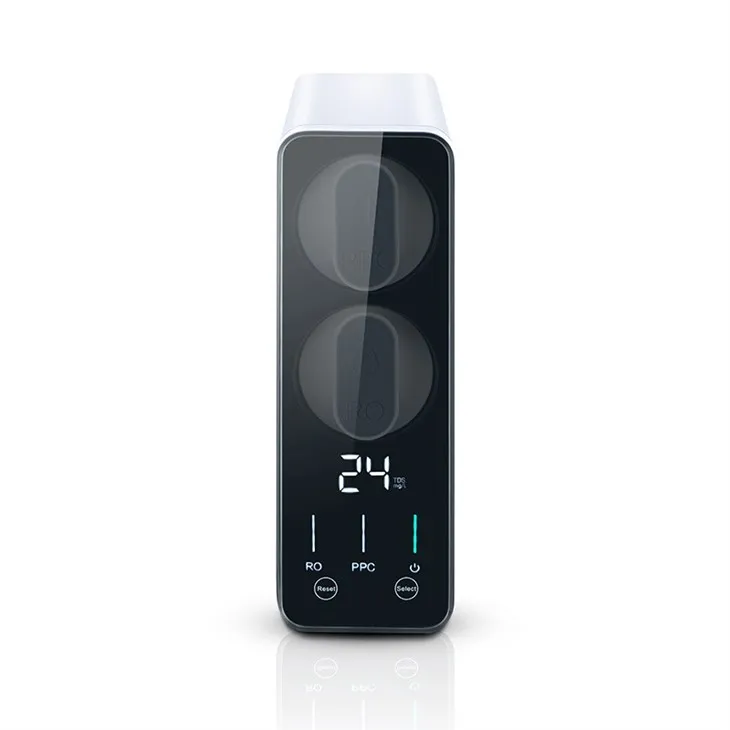
What is Reverse Osmosis?
Reverse osmosis is one of the most reliable and effective filtration methods for home drinking water , giving consistently high removal rates and providing total peace of mind.
At the heart of a reverse osmosis water filter is the membrane which is semi-permeable with pore size of approximately 0.0001 microns which effectively only allows the water molecules through and prevents any larger molecules of from passing through. A vast range of contaminants such as heavy metals, fluoride, chlorine VOCs organic materials or even viruses are prevented from entry.
The Stages Of A Reverse Osmosis Water Filter
Reverse osmosis water filters vary greatly in sophistication and quality. Whilst the RO membrane is the most essential component, to provide the best quality water, other filters are normally included
Stage 1: Sediment Prefilter
This is the first stage of the reverse osmosis filtration process, the sediment prefilter is used to filter out the dirt, dust, sand and debris among others. It can screen out 15 times more microscopic particles than a sand grain.
Stage 2: A Carbon Prefilter
Once the first stage is complete, the second stage starts. Here, the carbon prefilter is used by the best reverse osmosis water filter for home use. The pre-filter is used to enhance the taste and smell of water. In some water filters employ a 2nd carbon prefilter .
Stage 3: Reverse Osmosis Membrane
This is the stage when the semi permeable membrane filters out various dissolved solids and remove contaminants effectively. However, even the best reverse osmosis filter will not always remove 100% of everything. For example fluoride removal rates are normally around 94-97%, certainly representing a huge reduction.
Stage 4: Polishing Filter
This is the last stage of the water filtration process in a reverse osmosis water filter. Here, then a secondary activated carbon filter is often employed. This filter helps to make the water crystal clear for drinking.
Flow Rate
We sometimes get asked for a reverse osmosis system for the whole house. The undercounter reverse osmosis water filter systems sold for homes are not capable of such flow rates as would be required for whole house filtration and are suitable only as a source of purified drinking water. They are normally supplied with a separate drinking water faucet but may also be connected to a three way filter tap.
There are RO systems which can produce far higher rates of flow but these are industrial sized units which would be unsuitable for most homes. In these situations we would recommend installing a good whole house filter and then a reverse osmosis filter for the drinking water thereby providing the most comprehensive filtration of your household water available.
Tank or direct flow?
Traditionally, once the purified water has exited the filter system it is stored in a small tank from which it is drawn via the filter tap. However there are a number of issues with this, notably the need to regularly sanitise the tank and also the large amount of waste water produced by such systems.
Today the trend is away from tank use to direct flow in which the purified water is produced on demand. This has the advantage of space saving, providing freshly filtered water, eliminating or reducing the need for frequent santising and giving a significant saving on waste water.
Bountiful Benefits - Why Choose an Direct Flow RO Water Filter?
The reverse osmosis benefits are immense and go beyond just providing clean water. One of the major advantages of an RO water filter is that it enhances the taste of your water by removing contaminants that could otherwise compromise its flavor and safety. An RO system can also significantly reduce sodium levels in softened water, an essential point for those considering their sodium intake. Additionally, in a battle of Reverse Osmosis vs. other water filters, the former often triumphs due to its ability to eliminate a broad range of contaminants.
Once you have an RO system installed and have stopped relying on bottled water, you'll realize the many other benefits of pure water you're likely missing out on. With an unlimited supply of pure water, your pets can now also share in the health benefits of drinking water free of chemicals and contaminants. With pure water available on tap, you've got plenty to use for use in cooking, making coffee, tea, and other beverages. You'll even find plenty of new household uses for it – like watering your plants and cleaning! When you no longer have to ration your pure water from bottles, the possibilities are endless!
Let's talk about the RO system cost and maintenance. While there is an up-front investment with an RO system installation, it pays for itself in no time! Compared to constantly buying bottled water, using an RO water filter saves you money and reduces your environmental impact. As for RO system maintenance, it's pretty straightforward. Filter changes twice a year are all you need to keep your system running smoothly.
RO water treatment isn't limited to just homes. The same technology is scaled to commercial, industrial, and even municipal sizes and is used in virtually every industry worldwide. Many small local businesses, including restaurants and coffee shops, breweries, and craft food and beverage makers often use RO systems to ensure their food and drinks taste great and are safe. Other industries including nurseries, car washes, pharmaceuticals and food processing, rely on RO water purification to adhere to strict quality control standards. RO systems can be scaled and customized to fit the unique needs of homes, businesses, and industries.
With so many sizes, applications, and configurations, selecting an RO system can seem daunting when you first start looking into it. That's where we can help.
If you're looking to buy your first RO system to produce drinking water in your home, most people will choose a point-of-use (under-sink) RO System. These are installed beneath a sink (usually in the kitchen) and will dispense from a separate faucet, which is usually included with the system. When selecting an under-sink RO system, some things to consider are the size of your household, the space available, your water-use routines, and any other specific needs. A standard 50 gallon per day RO system is usually sufficient for a small family, but larger families or those who use more water may consider the larger 100 gallon per day size.
The answer to this question mostly depends on your water quality. Before investing in an RO system, it's best to check your water quality with a home water testing kit. You can also send a water sample from your tap to a certified laboratory in your area.
The aim here is to find out if you need an RO system, rather than jumping the gun and purchasing a system you didn't need in the first place. Depending on your water quality and the specific contaminants detected in your water supply (if any), you can decide whether or not to make the purchase.
Another factor to consider is whether you need clean, high-quality filtered water in your entire home or just at a particular faucet or appliance. If you are looking for the latter, then an RO system might be ideal for you. Keep in mind that RO water filters are point-of-use systems, meaning they treat water down the line and specific areas in your home. However, if you need a filtering system that treats water at the entry point, you might be better off with a whole-house water filtration system.
Reverse osmosis filters are ideal for use under the sink, for a refrigerator, well, aquarium, in RVs, and at businesses. They are sometimes used for agriculture and rarely used for the whole house. But despite where they're used, reverse osmosis systems improve the health and taste of your water. They feature multiple filtration stages and heavy metal reduction. They are also perfect for homeowners looking to address specific contamination issues with a filtering system that removes more contaminants than other water filtration systems.
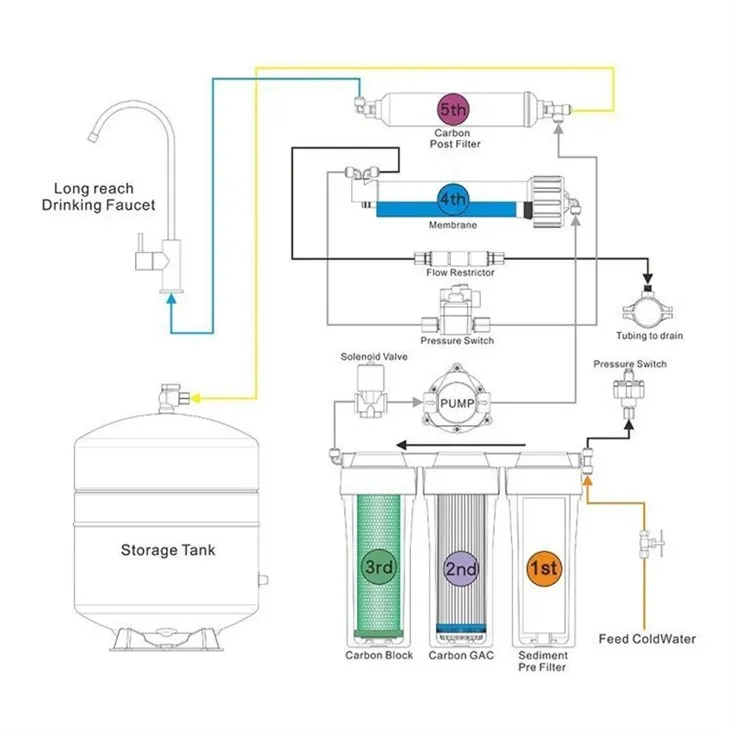
Reverse osmosis is the reverse of osmosis. As you probably can recall from science class, osmosis occurs naturally without any energy. However, to reverse the osmosis process, you need to apply adequate pressure to the more concentrated solution to "push" it through the RO membrane.
Usually, a high-pressure pump is used to increase pressure on the RO membrane's concentrated side and force the water across the membrane, leaving almost all the contaminants behind in the reject stream. Of course, the amount of pressure depends on the source water (aka, the feed water) concentration. The more concentrated the feed water, the more force is required to overcome the natural osmotic pressure.
Here's a brief breakdown of how the process works:
When the feed water first enters the RO system, it goes through prefiltration. Prefiltration typically includes a sediment filter and a carbon filter to remove sediment, chlorine, and other pollutants that could clog or damage the RO membrane.
Next, the water enters the RO membrane under pressure (enough to overcome osmotic pressure). The water molecules pass through the semipermeable barrier, while the dissolved contaminants cannot pass through. The water that makes it through the RO membrane is called the product water or permeate. It usually has around 95% to 99% of solid contaminants removed from it. Conversely, the system discharges the rejected pollutants through the reject stream. The reject stream either goes to the drain or is fed back into the feedwater system to be recycled through the RO system.
After filtration, the water flows to the storage tank, where it is held until needed. A reverse osmosis system continues to filter water until the storage tank is full, then shuts off.
Once you turn on your drinking water faucet, water comes out of the storage tank through another postfilter to "polish" the water before it gets to your faucet or appliance. Inline water filters are excellent post-filters. They are usually installed under the sink, out of sight, unlike filters that attach directly to the kitchen faucet. Inline water filters are also suitable for refrigerators, ice makers, coolers, washing machines, water fountains, boats, etc. The good thing about inline water filters for sinks is that they are always operating. That means there is no needed action other than turning the handle on your faucet. The best inline water filters usually have high filtering capabilities for a safe and healthy water usage experience. They also are compatible with multiple appliances, are durable, and easy to install and replace.
Osmosis System: Pure Water From the Kitchen Faucet
Toxin-free water for drinking and cooking, anytime! You shouldn't compromise on health, for your loved ones or for yourself. An osmosis system filters out pollutants of all kinds from your drinking water. Find out which aspects to consider when buying an osmosis water filter here.
A water filter in the kitchen pays off
The purest water from the osmosis system in the kitchen tastes great and improves your health.
Tap water in Germany is well controlled and of drinking water quality. Nevertheless, it can contain multiple pollutants. Our groundwater is contaminated with residues from pesticides, nitrates, and heavy metals. Bacteria and drug residues can also survive the filtering process in local waterworks.
An osmosis system is the most effective filtration system for removing these contaminants from tap water. That way, you know that you are drinking and cooking with the purest water possible.
An osmosis water filter uses the principle of reverse osmosis. In nature, osmosis refers to the natural process in which substances are evenly distributed in water. Reverse osmosis reverses this process: At the heart of the system is an extremely fine membrane that allows only water molecules to pass through. Pre-filters remove coarse impurities from the tap water.
Investing in osmosis water in the kitchen pays off several times over
A water filter in the kitchen guarantees that your family consumes only the purest water.
Osmosis water eliminates the need to buy mineral water and thus saves money.
It protects the environment, as it eliminates the production, transport, and recycling of water bottles.
Filtered water increases your quality of life, as you no longer have to lug boxes of water bottles around.
With osmosis water, it all comes down to the details
There's a large range of osmosis filters, and each system uses the principle of reverse osmosis. Therefore, it is important to pay attention to the details. The filter equipment determines how durable the membrane will be. For that reason, pay attention to the manufacturer's specifications about the quality of the installed filters.
Ideal placement for the osmosis water filter
The filter system is usually connected directly to the fresh and waste water connection under the sink. This means that the dimensions of the osmosis water filter play an important role when choosing a model. Ideally, you can have the device installed in the base cabinet under the sink. An additional faucet for the osmosis water will be mounted at your sink.
If this is a problem, you can choose a model without direct water connection; these so-called countertop units don't require installation. However, in this case, you need to regularly fill the device and dispose of filtered waste water.
Water tank or direct flow?
They are available with water tank or with direct flow. A unit with a tank filters water and stores it. This offers the advantage direct access with no waits. The water you take out is replaced immediately, which means older and fresher water will mix. To avoid formation of germs, the tank must be emptied completely and regularly. In addition, a system with a tank requires much more space.
Direct flow systems filter the water only when it is actually needed. In this case, a booster pump transports the water through a particularly powerful membrane. However, this means you'll have to wait a bit. Depending on the system performance, it can take a few minutes to filter a liter of water. For that reason, pay attention to the manufacturer's specifications on the speed of a system.
Important: Automatic rinses and wastewater
It is important that all reverse osmosis systems be rinsed regularly. This cleans the filters, so we advise choosing a model with an automatic rinsing function.
The ratio of osmosis water to wastewater also needs be taken into account. Modern systems have a ratio of 1:1.
Filters and vitalization
A good system will offer at least one activated carbon filter for pre-cleaning. This extends the service life of the membranes and thus reduces operating costs.
This kind of osmosis system also filters minerals out of the water. Some manufacturers there offer so-called vitalization cartridges, which enrich the osmosis water with minerals. However, this is not really necessary for a healthy diet.
The filters and the membrane of each system need to be replaced regularly. So before making a purchase decision, you should check what follow-up costs you will be dealing with.
Our Factory
Ningbo Blue Pluser Appliance Co.,Ltd, a Leader in Water Filtration with 300 Staff and 7 Production Lines, Nestled at the heart of our success is our state-of-the-art manufacturing facility. With 300 skilled professionals and seven advanced production lines, our factory is a testament to precision engineering and technological prowess. The facility is designed to meet the ever-growing demand for high-quality water filtration systems, ensuring efficiency and scalability in our operations.

FAQ
We're well-known as one of the leading direct flow ro water filter manufacturers and suppliers in China. Please feel free to wholesale high quality direct flow ro water filter for sale here from our factory. For more information, contact us now.
12 Inch Twist Quick Change Filter Cartridge, Water Faucet Soda, Water Faucet with indicator